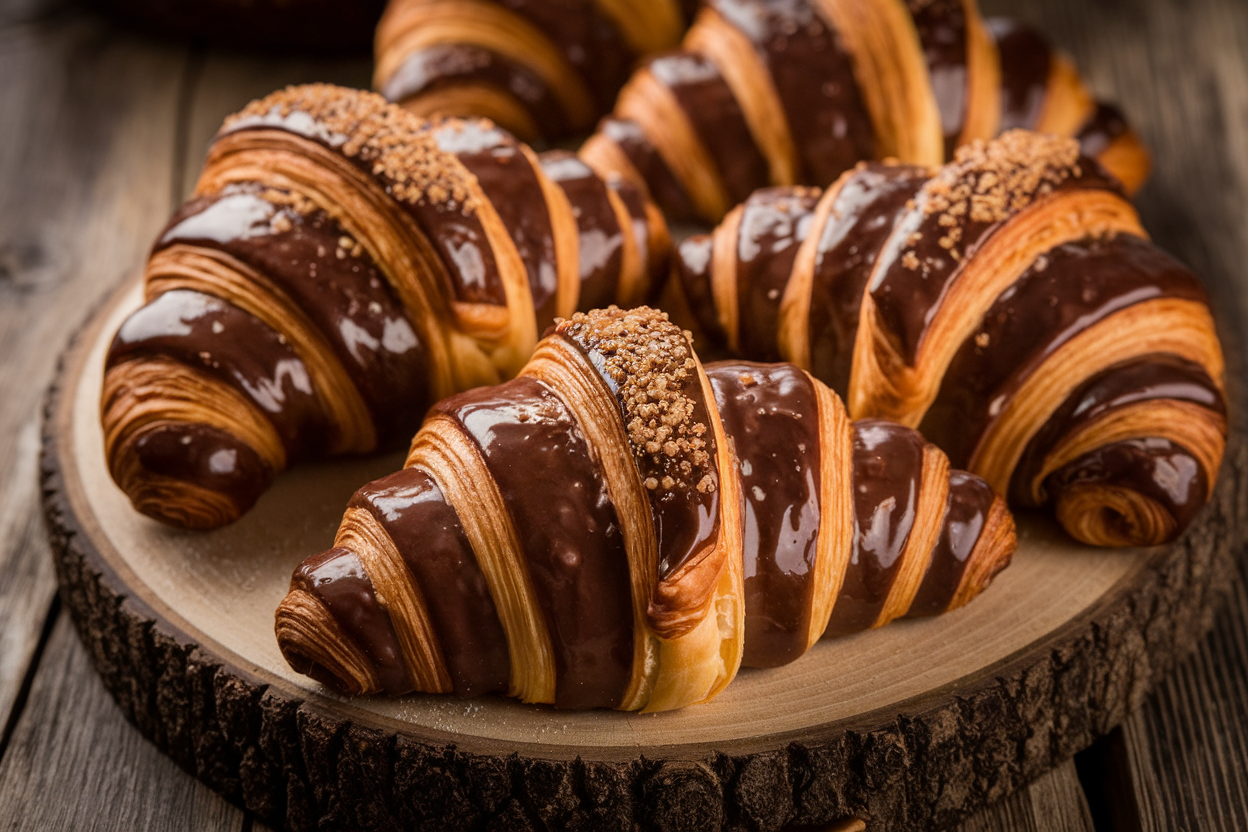
Homemade Chocolate Croissants That Taste Like a Paris Vacation (Without Leaving Your Kitchen)
You know that smell when you pass a bakery and your brain says, “Cancel the day, we’re getting croissants”? That can be your kitchen. Making Homemade Chocolate Croissants isn’t for the lazy—it’s for people who like results that make guests suspicious you’re secretly French.
We’ll laminate butter into dough, fold in chocolate, and bake something so flaky it should come with a warning. Yes, it takes a little effort. No, you won’t regret a single minute.
Why This Recipe Works
High butter content gets locked into thin layers through lamination.
When the dough hits heat, the water in the butter turns to steam and puffs up the layers, delivering that shatteringly crisp exterior and tender honeycomb interior.
Cold everything equals clean, distinct layers. Warm butter blends into the dough and ruins the flake. Chill between steps, and your croissants will rise like champs.
Chocolate batons or chopped bar melt just right without leaking.
The shape helps create those tidy, bakery-style seams and the perfect chocolate line with every bite.
Slow fermentation builds flavor. An overnight rest lets yeast do its thing, producing complex notes that no “quick” recipe can touch. Patience = bakery-level payoff, FYI.
Shopping List – Ingredients
- All-purpose flour – 3 1/2 cups (420 g)
- Instant yeast – 2 1/4 tsp (1 packet)
- Granulated sugar – 1/4 cup (50 g)
- Kosher salt – 1 1/2 tsp
- Whole milk – 1 cup (240 ml), cold
- Water – 1/4 cup (60 ml), cold
- Unsalted butter (for dough) – 2 tbsp (28 g), softened
- Unsalted European-style butter (for lamination) – 1 cup (225 g), cold
- Chocolate batons or good-quality dark chocolate (55–70%), 6–8 oz (170–225 g)
- Egg – 1 large, for egg wash
- Milk or cream – 1 tbsp, for egg wash
- Optional: flaky sea salt, powdered sugar, or a simple syrup glaze
Cooking Instructions
- Make the dough: In a large bowl, whisk flour, yeast, sugar, and salt.
Add cold milk, cold water, and the 2 tbsp softened butter. Mix until shaggy. Knead 3–4 minutes just until smooth.
Don’t overwork—it’s croissant dough, not a gym membership.
- First chill: Shape into a 1-inch-thick rectangle, wrap, and chill 30–45 minutes. Cold dough is easier to roll and won’t cling to the counter like a stage-five clinger.
- Prep the butter block: Place the 1 cup cold butter between two sheets of parchment. Pound and roll into a 6×6-inch square, about 1/2 inch thick.
Keep edges sharp. Chill while the dough rests.
- Enclose the butter: Roll dough into a 9×9-inch square. Place the 6×6 butter block in the center on the diagonal (like a diamond).
Fold dough corners over the butter to fully encase it. Pinch seams closed. If the butter feels soft, chill 10 minutes.
- First turn (letter fold): On a lightly floured surface, roll into a 8×20-inch rectangle.
Brush off excess flour. Fold the right third to center, then the left third over it—like folding a letter. That’s one turn.
Wrap and chill 20–30 minutes.
- Second turn: Rotate the dough 90 degrees. Roll again to 8×20 inches. Repeat the letter fold.
Wrap and chill 30 minutes. Keep it neat; clean folds make clean layers.
- Third turn (optional but recommended): Repeat the process one more time for ultra-flaky layers. Wrap tightly and chill at least 1 hour, or up to overnight for superior flavor.
- Shape the croissants: Roll the dough into a 10×20-inch rectangle, about 1/4 inch thick.
Trim the edges to square off. Cut into 8 rectangles (approx. 5×5 inches) for classic pain au chocolat size.
- Add the chocolate: Place a chocolate baton (or 2–3 thin sticks of chopped chocolate) along the short edge of each rectangle. Roll tightly one-third of the way, place another baton, then finish rolling, seam side down.
This gives you that double-chocolate line inside—no regrets.
- Proof: Place on a parchment-lined sheet, seam side down, with space to puff. Lightly cover with plastic or a clean towel. Proof at 75–80°F (24–27°C) for 1.5–2.5 hours until puffy, jiggly, and nearly doubled.
They should look alive, not sleepy.
- Egg wash and bake: Whisk egg with 1 tbsp milk. Gently brush the tops, avoiding the cut edges (or you’ll glue the layers shut). Bake at 400°F (200°C) for 8 minutes, then reduce to 375°F (190°C) and bake 10–14 minutes more until deep golden brown.
- Finish: Cool 10–15 minutes.
Optional: brush with simple syrup for glossy bakery vibes, dust with powdered sugar, or sprinkle a whisper of flaky sea salt. Then try not to eat three.
Keeping It Fresh
Room temp: Store in an airtight container for up to 2 days. Re-crisp at 325°F (165°C) for 5–7 minutes.
Freeze baked: Cool fully, wrap individually, then freeze up to 2 months.
Reheat from frozen at 350°F (175°C) for 10–12 minutes.
Freeze unbaked: After shaping, freeze on a tray until solid, then bag. Thaw overnight in the fridge, proof until puffy, then bake. Future-you will send a thank-you note.
Why This is Good for You
Mindful indulgence beats mindless snacking. One perfect pastry you made yourself is more satisfying than three mediocre store-bought ones.
Real ingredients, real control. You choose the butter and chocolate quality—no stabilizers or mystery oils.
Dark chocolate brings antioxidants and a little mood magic.
Skill building equals confidence. Master lamination and you’ll level up your kitchen game. That kind of win bleeds into everything else, IMO.
Don’t Make These Errors
- Warm butter during turns. If it smears, stop and chill 15 minutes. Smear = lost layers.
- Overproofing. If they collapse in the oven, they were overproofed.
Look for jiggly and puffy, not bloated.
- Over-flouring the surface. Excess flour gets trapped between layers and toughens the pastry. Light dusting only, brush off extras.
- Cutting with a dull knife. Use a sharp knife or pizza wheel so you don’t compress layers.
- Egg wash on edges. It seals layers and limits rise. Keep it on top only.
Variations You Can Try
- Hazelnut crunch: Spread a thin line of gianduja or Nutella with chopped toasted hazelnuts before rolling.
- Orange dark chocolate: Add 1 tsp orange zest to the dough and use 70% chocolate.
Finish with a light orange syrup glaze.
- Almond chocolate: Fill with chocolate and a teaspoon of almond paste; top baked croissants with almond flakes and powdered sugar.
- Salted caramel drizzle: After baking, drizzle with warm salted caramel and a pinch of flaky salt. Decadent? Absolutely.
- Mini pains au chocolat: Cut smaller rectangles and shorten bake time by 3–4 minutes for bite-sized party magic.
FAQ
Can I use active dry yeast instead of instant?
Yes.
Bloom 2 1/4 tsp active dry yeast in the cold milk and water mixture that’s been gently warmed to about 95°F (35°C) with a pinch of sugar for 5–10 minutes until foamy, then proceed.
Is European-style butter necessary?
Not mandatory, but recommended. Higher butterfat (82%+) means less water, cleaner layers, and richer flavor. Regular unsalted butter works, but results are slightly less flaky.
My dough shrinks when rolling—what now?
It’s tense.
Cover and rest it in the fridge for 10–15 minutes. Gluten relaxes, rolling gets easier, and your sanity returns.
How do I know they’re fully baked?
Look for deep golden-brown color and feel the sides—they should be set and crisp. If they’re pale, give them a few more minutes.
Underdone croissants are sadness wrapped in butter.
Can I make them the night before?
Yes. After the final turn, chill the dough overnight. Shape in the morning, proof, and bake.
Or shape the night before, refrigerate, then proof at room temp and bake.
What chocolate is best?
Chocolate batons are ideal; otherwise, use a bar of 55–70% dark chocolate cut into thin sticks. Chips don’t melt as smoothly and can puncture the dough.
Why did the butter leak onto the pan?
Likely under-proofing, warm butter during folds, or tears in the dough. Next time, chill more, proof longer, and make sure seams are snug underneath.
Do I need a stand mixer?
Nope.
A bowl, spoon, and your hands are enough. Don’t over-knead; minimal gluten development is key before lamination.
My Take
Homemade Chocolate Croissants are the edible definition of “worth it.” The process is part science, part therapy, and all flex when you pull them from the oven. Your kitchen will smell illegal, your friends will ask for the “bakery’s” number, and you’ll know you did it with flour, butter, and a little hustle.
Make a batch, freeze a few, and enjoy Paris on demand. That’s a luxury breakfast with ROI, no plane ticket required.
Printable Recipe Card
Want just the essential recipe details without scrolling through the article? Get our printable recipe card with just the ingredients and instructions.